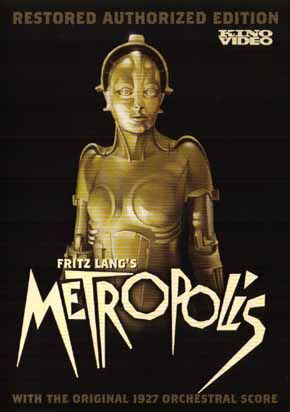
This week I dig out a movie so old it could be your grandfather, and perhaps obscure and lost enough to make your local cinema owner go "Oh, that's the city Superman lives in, right?".
"Metropolis" (1927)
Directed by Fritz Lang.
Perhaps most famously known for being heavily featured in Queen's music video for "Radio Gaga"
"There can be no understanding between the hands and the brain unless the heart acts as mediator."
- Maria
Prelude - Interlude - Furioso. Those are the three title cards that divide this film. And indeed it does bear more of an operatic feel as opposed to a cinematic one. Thus making it very difficult to get a proper frame of reference for it.
This movie is old. Really old for a film. It predates colour and it predates sound. It is even estimated that about a fourth of the original cut has been lost to time. Though in the meantime some more of it seems to have resurfaced. Nonetheless the edition I'm basing my review on here is a 119 minute cut restored in 2003. Sometimes the missing pieces help the pacing of the movie, other times it is actually vital points that seem to be missing.
Nonetheless, age and missing pieces aside, you would find this movie to be eerily familiar if you ever watched it, and yes, even if you're not a fan of Queen. Many of the shots and designs in the film echo through our counsciousness in the same way Quentin Tarantinos do the the cinephile. The difference is that while comparisons can be made to later films that almost certainly allude to this film (Star Wars, Frankenstein and both Tim Burton and Christopher Nolans versions of "Batman") the eerie feeling of familiarity comes from watching the view of the city of Metropolis itself and realizing how prophetic it way in it layout and design. A few redundancies of Sci-Fi aside, this is a late 20th century city.

As I mentioned, the movie is more operatic than cinematic. The plot revolves around a workers movement with slightly religious overtones that turns into a violent revolution once the beautiful leader Maria is replaced by a cyborg, constructed by the evil scientist Rotwang, who is seeking revenge on the city's plutocratic leader, Joh Fredersen.
All this is peppered with apocalyptic imagery, provided by the fantasy sequences in the mind of Fredersens son, Freders, who has also fallen in love with Maria. The plot itself is neither revolutionary nor really surprising to any modern viewer, perhaps it wasn't even in it's original day. But I think that has more to do with that story, like the imagery, is as if in a mythological Ur-state. An Ur-state that influences much that comes after it, giving a foudation to build upon and twist.
The films final morale (The quote by Maria above, which acts as a leitmotif throughout the film) may be either a bit to religious or a bit too socialist for your tastes. Personally I find that if one views this in the light of the latter, the movie actually loses a bit of it's operatic self-importance and becomes more of an incomplete Charles Dickens-sci-fi.
I doubt we will ever see a movie quite like "Metropolis" again. It is a visual tale, almost epic in its execution, perhaps to the point of being almost too much in love with itself. Those things have been found in many films since, but very rarely with such a pure and archetypical quality. If you ever wondered why cinema became one of the greatest art and entertainment forms, "Metropolis" provides one of the earliest answers.
And just because you didn't ask for it, Here's that Queen music video:


No comments:
Post a Comment